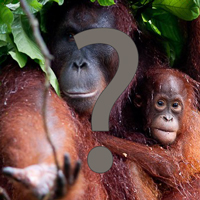
Quick orangutan Facts
Quick orangutan facts: Do you know where the name “orangutan” comes from? How do infant orangutans move through the forest canopy? When do male orangutans develop their flanges?
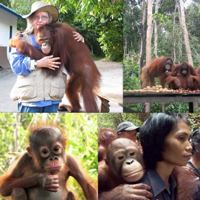
Gallery
See photos from the well known Camp Leakey, Lamandau, Tanjung Puting as well as watch videos about orangutans
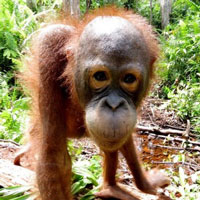
Orangutan Behavior
Social organization, male-male competition, life history, life in the trees, nest building, tool use, culture: Orangutans are a semi-solitary species with very slow life histories. They travel, eat, and sleep in the forest canopy, making a new sleeping nest most nights. Orangutans have a high level of intelligence which manifests itself in tool-use and the making of tools in the wild. Orangutans exhibit many socially learned traditions that are passed down from generation to generation
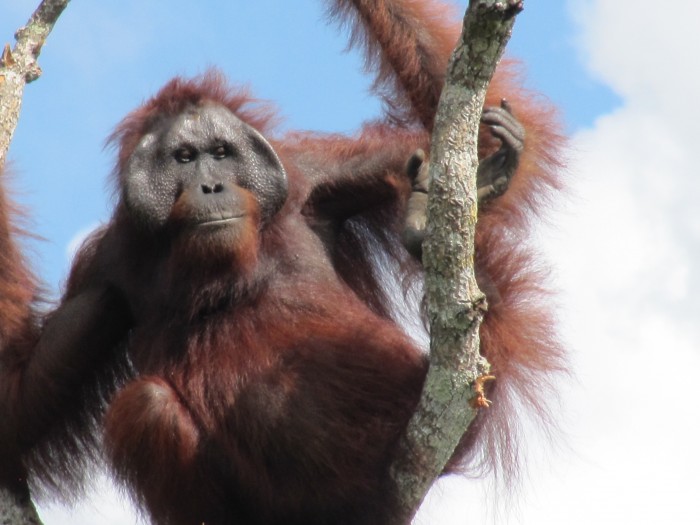
Orangutan Biology
Taxonomy, morphology, growth, evolution: Scientists recognize three distinct species of orangutans: Pongo pygameus on the island of Borneo, Pongo abelii on the island of Sumatra, and the recently discovered Pongo tapanuliensis on the island of Sumatra. They are the largest arboreal animals in the world and their bodies are adapted to eat, sleep, and move in the forest canopy. It is probable that orangutans diverged from the human lineage between about 12 and 15 million years ago.

Orangutan Ecology
Geographical range, diet: Orangutans are currently found only on the islands of Borneo and Sumatra with the Sumatran species limited to the northern part of the island. Orangutans on both islands are mostly found in peat swamp forests, tropical heath forests, and mixed dipterocarp forests. Orangutans eat ripe fruit, along with young leaves, bark, flowers, honey, insects, vines, and the inner shoots of plants.

Orangutan Conservation
The primary factor causing the decline of orangutan populations is the destruction and degradation of their tropical rain forest habitats. Human activities and development, such as logging, conversion of forest to palm oil plantations, mining, and urban expansion, are the major contributors to the loss of orangutan habitat.